This video is about the threat to American liberty that 'Common Core' is creating, but the reason I chose this as an expression of American liberty is that, Dr. Pesta has the freedom of speech and the liberty to debate and argue against federal decisions and projects without being oppressed by the government.
So what is Common Core?
"The Common Core is a set of high-quality academic standards in mathematics and English language arts/literacy (ELA). These learning goals outline what a student should know and be able to do at the end of each grade. The standards were created to ensure that all students graduate from high school with the skills and knowledge necessary to succeed in college, career, and life, regardless of where they live."
Dr. Pesta argues that these standards are not high enough, and that they are actually impeding the children's learning. Throughout the video he always has the American flag behind him which to me is extremely powerful as it shows me that even though he doesn't agree with the federal government he still has a love for America, which begs the question, does freedom come from government or is it a part of the American ideal that the government can't tamper with?
Furthermore Dr. Pesta quotes many statistics particularly of education and this also shows liberty and the freedom of information that all Americans have access to. Dr. Pesta is also the Academic Director of the FreedomProject Education (FPEUSA.org) again the ability to create and direct a project specifically designed to question and negate a federal scheme shows a specific liberty that many countries don't have, even countries that claim to have such freedoms and liberties.
I have chosen a video which shows the results of the Presidential Elections from 1789 to 2012 as an example of American liberty.
I chose this for two reasons, the first being that the right to vote shows the freedom American citizens have in being able to choose someone to represent them. The second reason that I chose this video was because it shows the gradual increase of the different states being able to vote. This shows how there has been an improvement in American Liberty from 1789 to the present day.
There has also been an improvement to American Liberty over the years as you can now be any gender and race to vote where as before when voting was first introduced you had to be a white male. In 1869 African American men were given the right to vote in the Fifteenth Amendment however the 'grandfather clause' was created so many black men were not able to utilise the new law. Women were given the vote in 1920 by the Nineteenth Amendment.
Some Americans are still not entitled to this liberty of voting as an age restriction means that you have to be eighteen to vote. This has been put in place as it is believed that anyone younger would not understand the government system properly and therefore their votes would be unsuitable. There is however some people that believe the vote should be lowered to the age of 16 with the argument that teenagers are responsible enough to drive at that age so why can't they have a say in their future.
Emma
Watson's recent speech at the UN promoting the ‘HeForShe’ campaign is an
expression of American Liberty. She is a feminist standing up for gender
equality and the campaign aims form males to be advocates for ending the inequalities that women and girls face globally.
She
expresses her right to the freedom of speech (the first amendment on the bill
of rights) but from this has come a lot of controversy; people either readily
agreed with everything she explained or didn’t agree at all.
In
her speech she highlights that feminism isn't just for women and isn’t about ‘man-hating’
which has become more recently associated with the term. Instead, feminism is
about gender equality; so men shouldn't feel pressured to be ‘masculine’ just
as women shouldn't feel pressured to be ‘feminine’.
Emma
Watson's message has clearly been received from some but her target audience was
aimed at males also. The letter, from Ed Holtom (15), is the view of one boy
who quite clearly agrees with Watson and the ‘HeForShe’ campaign. Quite different to this view, some would argue that the campaign is harsh towards men or is simplistic to assume that men have not been involved in work towards gender equality simply because they haven't been 'invited'.
Watson isn't the only female celebrity that is standing up for feminism, for example Beyonce is also very influential. However, Emma Watson may be one of the first that addresses both males and females.
I chose this video because it is an expression of American liberty.
The song is aimed at all patriots who are not afraid to stand up against tyranny, the U.S government and Americans in general. When the song is aimed to the U.S government, it is about Americans standing up to the government and that the U.S government is a government of the people, by the people, for the people. The song is also stressing the point that the government won't and can't control it's citizens.
This song has so many complexities to it because it raises political issues and it is aimed at the U.S government and Americans and 'warning' them about the government and what it's doing to the country e.g. that you are being 'controlled' by the government.
"We the people, we're going to fight, for our rights". This in itself is an expression of American liberty because the people don't have to be controlled by the government and by fighting for your rights, includes having liberty. In the song it refers to "we have the right to..." which again relates to the rights, and in the Declaration of Independence it states "certain unalienable rights".
"Here they come, they're coming for your guns". This is related to the 2nd Amendment within the 'Bill of Rights' 'the right to bear arms' which is an aspect of American liberty, as it is a right for Americans to 'keep and bear arms' as it 'shall not be infringed'.
"Are you ready to stand?". This in itself is an expression of an aspect of American liberty, as it shows that you are free to stand up and do something about the government. Also, in the Declaration of Independence it states "it is the Right of the People to alter or to abolish it, and to institute new Government, laying its foundation on such principles and organizing it's powers in such form, as to them shall seem most likely to effect their Safety and Happiness." and "it is their right, it is their duty, to throw off such Government, and to provide new Guards for their future security."
The second part of the video emphasises how much the government controls the people "control our tongue", "your free to do what they say" and "control our thoughts". You could argue that this part of the song questions whether it is an aspect of American liberty and whether the rest of the song is relating to the ideology of American liberty, especially as 'liberty' refers to so many different things including individual liberty.
"1776, does it ring a bell?". This is an expression of an aspect of American liberty because 1776 is when the Declaration of Independence was written and when the United States was free from Britain. Within the song they are using this sentence as a 'reminder' to the U.S government that in 1776 the United States had changed and that the government cannot control etc. the American people. "That whenever any Form of Government becomes destructive of these ends, it is the Right of the People to alter or to abolish it".
"Soldiers away from home". This is an aspect of American liberty because the soldiers that are away from home are fighting to protect American liberty, however some may consider this an ideological idea of American liberty, as there are other reasons that soldiers are away from home.
"We have the right to speak". This shows an aspect of American liberty as in the 'Bill of Rights' the 1st Amendment states "Congress shall make no law respecting an establishment of religion, or prohibiting the free exercise thereof; or abridging the freedom of speech, or of the press; or the right of the people peaceably to assemble, and to petition the government for a redress of grievances."
You could consider this song as somewhat having an ideological take of American liberty "I love Arizona, State of the free". This is because technically all of the States are 'free' because they are all United.
This song in itself is an expression of American liberty because it shows the exercising of American rights.
Carlton Douglas Ridenhour (Chuck D) was born in Long Island and grew up with both parents being political activists. Whilst at school, Carlton was interested in hip-hop music so he became involved in making flyers and co-hosting on the school radio station. It is by doing this that he met Bill Stephney and Hank Shocklee who he created Public Enemy with. Public Enemy broadened the hip hop genre to white audiences as it was previously seen as a black music genre. Chuck used his new audience to become a spokesperson for the black community writing lyrics such as "Some ask us why we act the way we act without lookin' how long they kept us back" in 'Righstarter (Message To A Black Man)'.
Chuck D said in the past that "Rap is black America's TV station" however he seems to change his mind later on in his life as he says in an interview that "rap music is the world wide religion of people 25 and under, and we have to watch the King James version" This shows his view that rap music can be for both black and white audiences but people only see what the internet and the TV allows them to see. Their views on rap music are decided by the media.
Chuck D is currently touring with Public Enemy around the world and he still continues to speak up for black Americans and how they are treated. I think that Chuck D is a great example of a successful African American who isn't afraid to stand up for his race and try to improve stereotypes that black people are given.
Sources: http://www.mtv.com/artists/chuck-d/biography/ http://www.imdb.com/name/nm0195982/bio?ref_=nm_dyk_qt_sm#quotes http://www.azlyrics.com/lyrics/publicenemy/righstartermessagetoablackman.html Journal Article: Thorpe David and D Chuck, "Chuck D" BOMB, no. 68 (1999): 41.
Barack Obama was born in Honolulu, Hawaii on August 4th
1961. He was a civil rights lawyer and teacher before pursuing a political
career. Obama is the 44th and current president of the United States
and the first African American to hold office. [1]
Being the first African American to gain presidency would
suggest that America has moved forward and that ‘race’ is a historical product
that is ever changing. However, during Obama’s campaign to run for president,
there was a lot of controversy as to whether or not he should play on his race
(and whether he did or not is still highly disputed among some). “Many African
Americans said that, in order for Obama to win election as President of the
United States, he could not bring up race during the campaign” in order not to
alienate many white liberal constitutions; although the fact that he did this
would suggest that racism is still a large problem in the US.
The journal article goes on further to illustrate,
although Barack Obama has made history in being the first African American
president in the United States (and that is progress in itself), that he is not
“acknowledging the black ancestral struggle that preceded him and which in many
ways opened the doors to his rise in American politics”. Obama has ran campaigns
for and promoted ‘Change in America’ however
when compared to someone such as Martin Luther King and other African American
activists, it would be hard to bring something like this about without bringing
up race. This makes you wonder whether or not the US will ever be fully equal
and without racial discrimination, even in light of the political breakthrough
of Obama becoming the first African American president.
Journal
Article: Asukile, T, The Barack Obama New Era: Race Matters More Than Ever in
America, The Black Scholar, 38(4),
BARACK OBAMA 2009 (WINTER 2008), pp.41-43, Published by Paradigm Publishers,
Article Stable URL: http://www.jstor.org/stable/41069364
Beyoncé Knowles is an American singer raised in Houston,
Texas. She was originally a member of a girl group called Destiny’s Child, but
she went on to create her own very successful solo career. Currently her newest
album holds the position of the most downloaded album on iTunes, with 828,773
downloads. Beyoncé performed at President Obama’s second inauguration in 2013,
which shows just how known she is, as she was asked to perform at such a
prestige’s event to such a large audience.
Beyoncé is part African American and part Creole, and
despite this and her being a women she has still won 16 Grammys, made the
Forbes Top 10 list of entertainers and earned an estimated $350 million as of
2014. This all shows how peoples view on race have changed as in the past an
African American/Creole female singer would not have been able to gain this kind
of popularity and success. Beyoncé’s fame is an example of how society’s views
on race have changed since the past to allow someone of Beyoncé’s heritage to
have such a successful career.
Beyoncé has also had a positive impact on many people as Beyoncé
has sang of female empowerment and at the recent 2014 VMA’s she sang in front
of a large sign saying ‘Feminist’. She then went on to describe the meaning of
the word, this is a significant event as it shows an African American women
proudly stating how she believes in equality.
To conclude, I believe Beyoncé is a great example of how an
African American/Creole women can be treated in today’s society compared to the
discrimination she would have faced in the past. Due to the changes in the
views on race Beyoncé has been able to reach the level of stardom she has
achieved.
Who is Oprah Winfrey?
Biography.com says "Billionaire Oprah Winfrey is best known for hosting her own internationally popular talk show from 1986 to 2011. She is also an actress, philanthropist, publisher and producer." Oprah Winfrey is a household name in the US, and even in England. Even if someone doesn't really know what Oprah does they usually know she is a African-American woman. It is this link that Oprah has with race which adds such significance to her success. Forbes have given Oprah a 'self-made score' of 10 (10 being absolutely self-made with no wealth coming from her family inheritance) and as of 1/11/2014 her net worth is at $3 billion. Oprah was born 10 years before the Civil Rights act of 1964 took place, this act made it illegal to discriminate based on race and gender as well as other factors, so for the first 10 years of her life as an African-American female discrimination was more than legal, it was the done thing. Following the Civil Rights movements through the mid-sixties this opened a huge number of opportunities for black people and women and it meant that Oprah was able to go onto University which is an option that just 20 years before she may not have had or it would have been a black-only University. From University Oprah gained recognition on a Radio show from which she was asked to host A.M. Chicago for 8 years and she then went on to host her own TV show, The Oprah Winfrey Show. So why does Oprah have an influence on race in the USA? It's possibly because she has proved to so many African-American's that not only has an African-Americn 'made it to the big leagues' but she is a woman also which shows that this white male dominance is a thing of the past. Anyone who says that problems in race haven't changed much in the past 60 years I would ask them to look at Oprah Winfrey and tell me that racial equality hasn't changed dramatically for the better. Another question to ask is has Oprah contributed to racial equality? Yes I believe she has, Oprah is one of the most influential women in the USA and just because she hasn't been the leader of any political parties against racism does not mean she hasn't changed peoples views on race. In fact she has managed to change views on race right in their living rooms on their TV sets.
Race issues are ever changing but it is easy to say that someone like Oprah has had a positive impact on the way race is viewed and dealt with in popular culture and society.
Carol Moseley Braun:
Carol was an American politician and lawyer who represented Illinois in the United States Senate from 1992-1999. Being an African-American shows that there has been a huge amount of change with race and the United States because Carol Braun is an example of the difference between now and 100 years ago. This also shows progression as well because for an African-American to be represented in the Senate, proves that race is no longer an issue nowadays. It also shows progress because it is an African-American woman and not a man- which shows that equality has also progressed along with race.
However, the idea that race has changed and progressed could just be ideological because whiteness shifts over time and slowly brings in immigrant group after immigrant group, so that eventually they become 'white'. Also there are different terms for race for example, coloured and not black means that the white and black binary is changed and this makes it equal. Or race may have changed because race is a historical product and is a cause of racial thinking, so people's mindset has probably changed over the years 'allowing' Carol to become a politician and a lawyer.
Since 1992-1999, there hasn't been another African-American woman in the same position as Carol which may indicate that there actually hasn't been any change at all and that Carol was a 'one off''. However this could just mean that modern day African-American woman don't want that kind of job, or the population is predominately non-African-Americans, or that race actually hasn't changed even today- when equality is as equal as ever.
Journal article: What ever happened to... Carol Moseley Braun?
This is an interesting article which makes you question race in this day and age and whether it has made any progress etc. over the years.
"She ran for president in 2004 because of a conversation with her young niece, who pointed out that "all the presidents were boys.""
"Moseley Braun was the first, and to date only, African-American woman elected to the Senate."
"Moseley Braun says she has no plans to run for elected office again."
First of all the first quote shows that the lack of woman in politics was really obvious because a child could point it out, and that even though Carol did get represented it wasn't the norm- which must have been inspiration for many African-Americans and African-American woman especially. However this does also show that if you are determined enough, opportunities are there in the USA, even with incidents like this when it may seem like it is not an option.
The second quote shows that there was a breakthrough relating to race because she was the first, but then it goes on to say the only, as if suggesting that race hasn't actually progressed at all or at least very little since then. Although there has been an African-American president- but it isn't a woman.
The third quote suggests that she has made her point that African-American woman and men can be represented in the Senate (because she has done it), and this shows that race must be progressing because 100 years ago it may not have been the case that Carol was representing. But when it says that she has no plans to run for elected office again shows that it is possible to become a politician but you can only go so far, which makes you question whether race has changed over the years or not.
Sources:
http://www.biography.com/people/carol-moseley-braun-205626#synopsis izquotes.com
Journal article: By Lunney, Kellie, national journal, 03604217, 11/3/2007, vol. 39, Issue 44
12 Years a Slave is a popular film that has won many awards such as an Oscar, a BAFTA and a Golden Globes award. When watching the film, it is clear to see why it has impressed so many people.
12 Years a Slave takes on the subject of African American slavery and shows it from the perspective of the slave instead of the white master. The effects this has on the viewers is that they feel sympathy for the slaves and are resentful towards the white owners. This isn't the case for all of the white characters though as Ford and other men are admired for helping Solomon.
My initial reaction to this film was sadness for Solomon and the rest of the slaves as they had their whole lives taken away from them. This emotion developed after reflecting on the movie as I realised that this was seen as socially acceptable in America and people were treated as badly as the film portrayed. What shocked me most about the film was that the character of Solomon was a respected man at the beginning and was treated equally to any white man living in New York. Going from this idea that we see in the present day to being downgraded and treated like an animal made me feel very distressed as it presented the idea that it could happen to anyone.
Due to the fact that 12 Years a Slave is a film which means it is created to keep viewers interested, we have to take into consideration that it might only show the worst parts of slavery and not the boring daily routines slaves would have to tolerate. This therefore means that the film is not completely reliable at showing us how African American slaves lived and were treated. The story of Solomon is also the representation of one character and even though we meet other slaves, we do not follow their story lines completely so we do not know the positions they were all in.
Overall I think that 12 Years a Slave is a very good method of showing audiences how African American slaves were treated, however we cannot fully trust the film to be an accurate representation of this as it is made for the purpose of keeping viewers engaged and therefore it only shows the most dramatic parts of slavery. This isn't a film that I would like to see again as it is deeply upsetting to watch however I believe that everyone should watch it once to gain an idea of how badly African Americans were treated.
The film 12 Years a Slave depicts the life of a man who is
stolen from the North, transported to the South and sold into slavery. The movie
follows the true story of Solomon Northup which is based on his memoir which he
wrote documenting his kidnapping and sale into slavery. The process by which
Northup was kidnapped, broken, sold into slavery, and then subsequently
oppressed and resold was far too common and the tale of what many slaves went
through. Although his situation was extraordinary because he was kidnapped from
the North the situation he faced once enslaved is an accurate portrayal of the
horrors that were faced by African Americans during the time of slavery in
America.
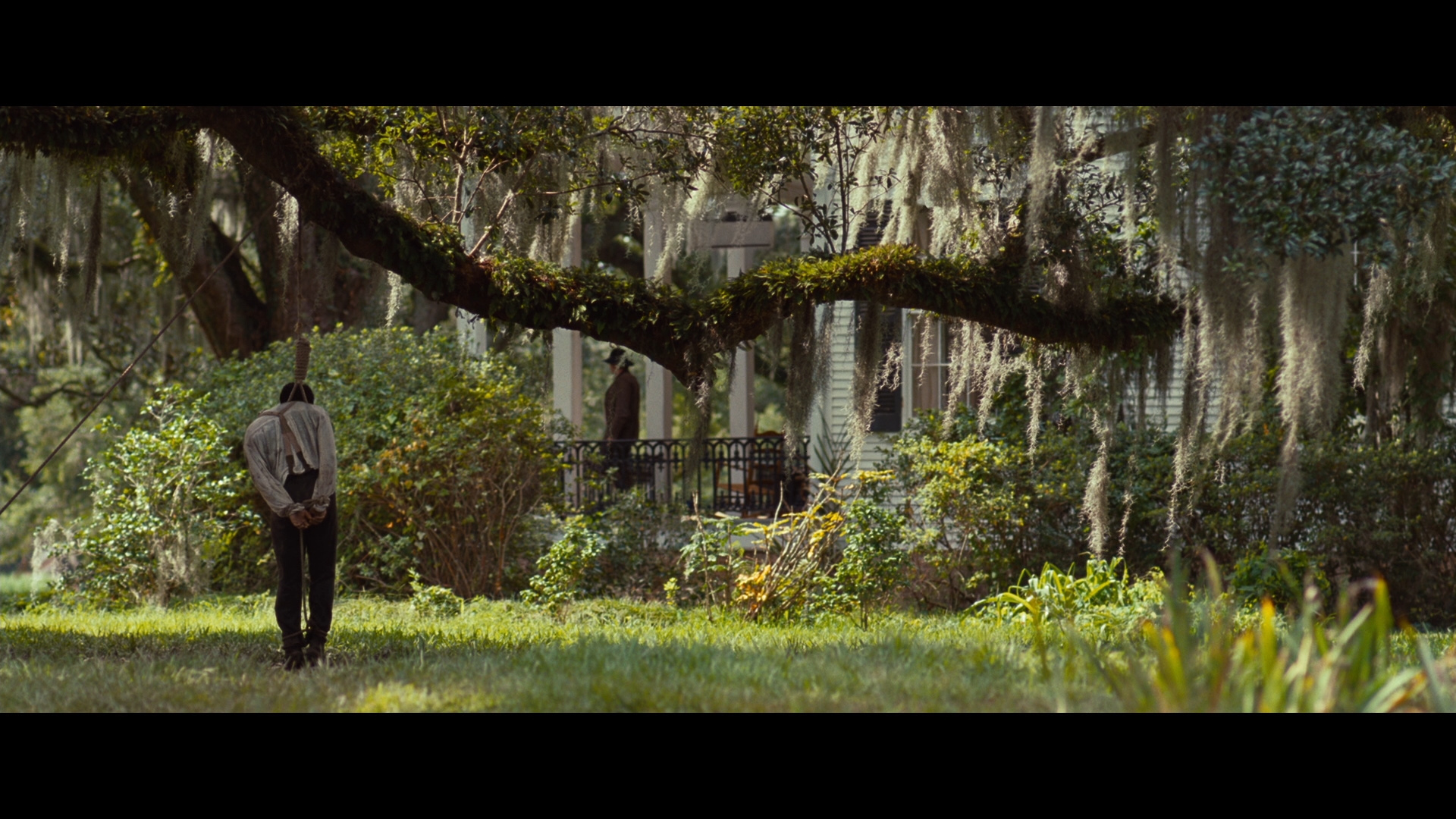
The beautifully shot landscapes should be idyllic and often
resemble something of a painting but placed in the film throw up huge conflict
as they remind you more of the blood and suffering and make you think that the
brutality of man is disturbing the natural beauty that the South has to offer.
Benedict Cumberbatch's character, Ford, portrays a seemingly
decent and caring man who treats his slaves with some respect and kindness,
giving Northup a violin for example. He comes off as a relatively good man who
is trapped within the powerful confines of the institution of slavery, however the fact
that he reads the Bible to his slaves to give them hope that once they die they’ll
go to a better place is twisted, he does nothing to help or free them which
make me think that he is no better than the other slave owners. Personally I think
12 Years A Slave manages to depict
slavery well as something that can drain the humanity from everyone it touches; for the slaves themselves it manages to break all hope that they may have of
being free, turning them into shells of people for their owners to do with as
they please, characters such as Ford who are seemingly good men are still shown
to exploit people and do very little or nothing to help them, for example when
Northup is hung by the neck with only his toes barely touching the floor but
life around the plantation goes on undisturbed, furthermore it turns flawed men, such as Epps
(played by Michael Fassbender) into villainous monsters who have too much power over people who deserve to be treated much better than they are.
I think that although the film is based on the memoirs of
Solomon Northup and the story is shown through his eyes, it doesn’t linger too
much on him personally, it gives us great detail about each of the characters that are met in subtle ways. I think it does this particularly well with all the female
characters; Patsey and Epps’ wife specifically.
Patsey seems to be the polar
opposite of Northup; she is a broken girl who has never known dignity as she
was born into slavery, she is forced to endure the ‘love’ of Epps and the
brutal jealousy of his wife in a life that she knows she will never escape. However
within this she still portrays a level of innocence that depicts only further
tragedy for her character, in an amazing emotional performance.
Overall, the film 12
Years A Slave offers an accurate representation of slavery in Southern
America at the time. It is a heartbreakingly emotional film, made up of a well picked
cast, who are able to show the agony and despair of the slaves, the bitterness,
jealousy and villainous behaviours of the slave owners and all in all are able to portray
the memoirs of Solomon Northup well and justly.
I do not feel I can say I enjoyed the film 12 years a slave as I don’t feel that
this is a film to be enjoyed. The film is well made, but it is not meant to be
easy to watch or entertaining, it is meant to show a true story in all its
horror. There is nothing fun about watching it, its purpose is to show Solomon’s
story and give us a visual retelling of what was most likely a common occurrence
at the time.
At the beginning
of the film Solomon is tricked and kidnapped into slavery. At first this seemed
pointless to me, why would the ‘circus men’ go through all of that just to gain
a slave? But then I realised that it was because they did not have to purchase
Solomon to then try to sell him on to make a profit, they got him for free so
they were guaranteed a profit. It was obvious that they knew Solomon was a free
slave and so there must have been very little in the way of punishment for
slave traders who were caught selling a free person under the pretence that
they were a slave. The only reason those men wanted Solomon was so that they
could make a profit, they did not think of his family or what they would be
selling him into. I imagine this would be a fairly common occurrence at the
time, which shows that even though a free man is legally free many slave
traders and masters would not care as they still saw all black people as
property no matter what their free papers said.
Even before
Solomon’s kidnapping the film shows that the idea of a free slave at the time
was rare, even though it was legally allowed. During the beginning of the film
Solomon and his family are shown going about their daily business, including
entering a shop to buy a bag for Solomon’s wife, Anne. During this scene we see
a black man enter the shop behind Solomon and look around with a confused
expression. The shop owner treats this confused man as if he is just a normal
customer, as he should be, but we then see that this confused man is a slave
when his master comes into the shop to angrily collect him. This shows that
being a free black man at this time would have been strange for many slaves, as
I assume they would wonder why they are a slave and the free black man is not.
This strengthens the idea that it was easy to kidnap a free black person as for
many slaves and white people it would be unheard of in their community for a
black person to be anything other than a slave.
The changing of
Solomon’s name to Platt shows that slave masters would give their slaves new
names to dehumanise them, somewhat like giving a new pet a name. This is also
shown by how the name Platt is not a name a white man at the time would have,
it is a name a person would make up to give to their dog not to give to their
child.
One negative criticism I have of this
film is that I feel it would have been a much stronger portrayal of slavery if
the film followed the life of female slave. I understand that this film was
based on a true account and thus follows the life of the man who wrote this
account, but I feel that from watching this film the life of a male slave would
have been less complex that of a female slave.
As we saw in
this film families were split up when sold, including taking children away from
their mothers. During the scenes where Solomon is being sold we can see a slave
trader willing to sell a mother and her son but not her daughter, as the
daughter would be worth more as she will grow up to be beautiful due to the
fact that she looked more ‘white’. The mother obviously new that her daughter
was essentially being kept because she would be worth more because for her
sexual appeal later in life. This must have been devastating for both mother
and child, and yet we only see a small glimpse of this truth in the film. We
see that the mother later on is distraught over losing her children and cannot
hide her grief no matter what Solomon says to her. Solomon knows his family are
safe, this women doesn't know where her children are and whether she will ever
see them again.
I feel that
the life of a slave like Patsey would have been a much more complex film based
on just the glimpses of it we see in the film. The way she is prized for her
speed at picking cotton, yet still treated like less than human like the other
slaves even though Epps is quite obviously sexually attracted to her. The fact
that no one, other than Epps wife, complains about the relationship between
Epps and patsey shows that there is more of a story behind this kind of
relationship between an unwilling slave and the slave master. Epps treats
Patsey as if there is nothing he cannot do to his slaves as they are his
property, and I feel if that if the film followed a female slaves life this
would be explored more.
This film does
show that slavery was different depending on a slaves gender and age, a young
man was seen as perfect for working in the fields where as an older male slave
is seen as trustworthy enough to have a small amount of power over the other
salves. This is shown in the film by an older male slave telling Solomon to get
off the porch and an older slave wielding a whip and telling the other salves
to keep working in the fields. Younger women were made to tend the house or do
less physically demanding work in the fields, and they were more highly priced
if they were attractive, which again hints that female slaves were used for
more than just their work and that slave traders were well aware of this fact
and as a result raised the price of attractive female salves. Older female
slaves seem to have been more trusted to do the house work, and as the film
shows in some occasions a female slave may become the partner of a white slave
owner.
The
relationship between Ford and his slaves is interesting in this film as Ford is
seen as a kind and lenient slave master and yet when Solomon tells him he is
free Ford gets angry because he doesn't want to know about it. I feel as if
Ford acts under the idea of plausible deniability, if he doesn't know a slave
was a free man he doesn't have to think about it or do anything to help that
slave. This contrasts with Epps who
would very obviously disregard any problems a slave was having, such as at the
end of the film when he was adamant that Solomon was his property and not a
free man.
To conclude, I believe
that this film is a very complex film and could be analysed in many different
ways. It shows the truth of slavery from the events that happened in Solomon’s
life, yet I feel like it could have explored the lives of female slaves in more
detail. It gave a good account of the different types of slave masters and the
various mind sets held by different slaves. The fact that it is from the point
of view of Solomon, a slave rather than a white man is interesting and is what
makes this film so important. Although the type of person Solomon is does
effect the view we get as viewers, the film is still from a slave’s perspective
and it does show many aspects of slavery in a compelling and shocking way.
It is hard to say that 12 years a slave is 'brilliant film' because that is not what it is attempting to be. It isn't trying to be a film that people can watch time and time again and it shouldn't be, what the film is doing is educating and portraying the U.S' past sin. You only have to watch this film once to understand the intent of the film and the director Steve McQueen -who is also African-American- does it so justly.
The image above is of Anna's (Ashley Dyke) back following Burch (Christopher Berry) having made Solomon (Chiwetel Ejiofor) whip Anna, as this image came on the screen it made people cringe, that reaction is far from surprising. Rather than talking about the reaction of the audience it's the reaction of the characters that is most important. Solomon struggles to beat Anna and you can see the pain it causes him whereas Burch and his wife have no problem watching this unfold and of course are forcing it to be done, even though Burch was in fact in a sexual relationship with Anna.
It is apparent that the beautiful scenery completely contradicts the deadly sin that is taking part within it. As well as the presence of religion which has an almost hallowing influence on the film especially on the plantations.
This image above has 4 parts to it; the righteous white man standing up front speaking gospel, the gorgeous scenery and arch-way sprouting life, the black people sat down looking up to the white man and finally something that is only in the audio of the film, the whaling cries of Eliza for her children.
This scene is most of the film wrapped into a space of about 2 minutes, white ignorance, black oppression and fear, religion and scenery.
The film truly does make the audience think about the problems being addressed but the sad truth is that this film is the truth. It is not fiction, fake, fable or a fantasy. It is the truth and yes there will have been areas where slavery wasn't as brutal (careful to not say as 'bad') but there are places it would have been more brutal, harsh or otherwise.
To bring this review to a close, 12 years a slave is not a 'brilliant film' it is a film that does the world a justice, there is not yet a word -that I can think of- that describes how and what the film does, not just the U.S, but for the world. It is an eye-opener for any viewer and is a must-watch before you die.
12 years a slave- I think this film is an amazing film because it is really entertaining but also because how it portrays slavery. The fact that the story line is presented in the eyes of someone who would have been a slave and their views of slavery and that it is not in the eyes of the slave owners as their views on slavery would have been completely different, this gives a much better understanding of what slavery was like and how the slaves were treated as well as how they would have felt too.
I think that the key features of the condition of slavery in the film is that the woman and the men cost different, depending on their value as there would have been different jobs like plantations and a house slave. However women are treated just as bad as men, and this is shown in the film when the young woman got whipped by the main character because she went off to get soap.
The film is a great film for showing the reality of slavery as it shows that a free black man who has a family etc. can be living his life and then suddenly become a slave if he is not too careful-because he trusted the two white men at the beginning of the film. It also shows the reality of slavery because it shows the dominance of the white people and that they have control over the slaves, because they took away the main characters papers, so he couldn't prove that he was a free man. This shows that the slaves were treated like animals and not people. Another interesting point that the film highlights is that the two white men decided to get a black man (not caring if he was 'free' or not) and this shows what the mindset of the slave owners and slave catchers were like, because they only cared about their lives and not about people who were black but not actually slaves.
There was one significant anti-slavery voice in the film which was the Canadian man which I found one of the most interesting parts of the film and the way it portrays slavery. The film makes a really good scene where the Canadian is white but is working for the slave owners (but actually gets paid, has his own cabin and doesn't actually have to be there and can go whenever he chooses), and he his working with the slaves and doing the same jobs as them. I liked this bit of the film because it really made it clear in how bad slavery actually was, because the slaves had to stay there etc. But what is also really interesting is when the Canadian man talks about how the slaves are treated and the fact that he actually disagrees with what the slave owner is saying and doing to the slaves, yet because he is white he doesn't get punished for talking, but if the slaves spoke then they would be punished.
I found that there was some difference between Ford and Epps despite the apparent kindness that Ford shows to Solomon because I think that Epps takes advantage of the slaves more because he regards them as his property and that he paid for them so he can do what he wants, and doesn't think about how the slaves might feel.
When the slaves sing the song "Roll, Jordan, Roll" it really expresses the despair of slavery and it shows that slavery was really bad and that the slaves were really desperate and that there was no hope and no way out.
The beautifully shot landscapes defiantly shows conflict between the representations of the South and the cruelty of slavery that occurs because slavery is the complete opposite of the location in where the film was set. It is very contradicting and it makes slavery invisible because of the beautiful landscapes around it.
With the whipping of Patsey scene it shows that slavery was considered normal during that time and that Epps doesn't see the black people as people and humans but as animals/property as well as not people like them.
When Solomon returns to his family he doesn't show happiness because he feels like he has let his family down and that he has also missed the years with his family and his children growing up, and just generally feels that he has missed a huge part of his life (12 years). And the fact that he has waited ages to see them too.
When the slaves were often shown wandering between plantations without apparent surveillance this suggests that a) That the slave owners made sure that the slaves knew the consequences if they did escape and not make it. And b) The mindset of the slaves is already installed in how they should behave and what they should do/not do.
I think that the overall film is a great portrayal of slavery because it shows more than just one perspective and one thing about slavery such as families being apart, it also shows children in slavery and what the life of slavery would have been like in general. The film is really good in how it starts with the black man free, equal and normal and the same as any other free man, whether they are black or white, but then the rest of the film shows him a slave, and this is good because it shows how cruel slavery really was.
Tempie Cummins starts off her narrative by saying "The white chillun tries teach me to read and write" this surprised me when I first read it as it describes white children not showing the same discrimination as adults seem to have for African Americans as this time. This could therefore suggest to us that racism is something that is learnt through society rather than it being a natural instinct. The fact that the children are having to teach Tempie tells us that they are further educated than her even though they may be younger. This shows us that education for white children was more highly regarded than it was for black children.
Cummins then says "I allus workin" which shows us that she wasn't treated any fairer because of her young age and that she was still expected to work the long hard hours that adults would be given. This again shows the lack of compassion for African Americans.
Tempie later explains that "When freedom was 'clared, marster wouldn' tell 'em" this shows us that the slave owners just wanted to get as much work out of them as possible even if it was now not allowed. This reflects the views of many who only regarded their slaves as a labour force instead of humans with rights.
Tempie explains that when her mother hears of this new freedom she runs outside whilst the "Marster, he come out with his gun and shot at mother" this sort of action would be typical of a farmer trying to catch one of his animals when it runs away which implies that the slaves were seen as animal-like. This also shows us that the master did not care about the lives of his slaves and would rather murder them than let them escape his control.
I chose the person, Virginia Sims, as the name intrigued me. I thought if this women was born into slavery the chance is that Virginia is the name of the state she was born in, funnily enough I was correct.
The narrative opens "I was born in 1844. I was twenty when peace was declared. I was born in Virginia." Now I don't know for sure who named Virginia, but if it was her mother the likelihood is that she had little or no education so named her after the state as she didn't know many other names to call her. Though if she was named by the family that owned her at the time they probably didn't care enough to think of a name for her.
What strikes me about this opening is that she knows her exact age when 'peace' was declared even though at the time of the interview Virginia was 93. This was most probably the biggest thing that happened to her throughout her entire life after having been born into slavery.
Though Virginia was born in Virginia she wasn't there very long as she goes on to say "but I was sold, put up on a stump like you sell hogs to the highest speculator". This was a sad but true fact of slavery people were being sold and auctioned as if they were simply cattle. For someone of such a young age at the time it sounds disturbing to us now but it was completely acceptable at the time in states such as Virginia.
On the following page Virginia recalls a meeting she had "I member they was a white man called Dunk Hill and he said, 'Virginia, who free'd the niggers?' I said 'God free'd the niggers.'" This small recollection tells me a lot about Virginia as just from her grammar 'they' instead of 'there' shows me that she didn't have much of an education from a young age and continuing into her later life she will have been around a lot of people who weren't educated as a young age as well because then her grammar would have most likely improved, this was probably due to the segregation that followed the liberation from slavery. Just as well she refers to her peers as 'niggers' when responding to the 'white man' this is most probably because she didn't know any better. If this poor women had been born into slavery she would have been referred to as a 'nigger' from an extremely young age.
A surprisingly small amount of people know where the term 'nigger' comes from and this is because it tends to be a very taboo word especially for the 'white man' it comes form the Spanish word Negro which descends from the Latin word Niger. This meant either 'colour black' or 'to blacken'. It is the way the term was used which built it's offensiveness as it was supposed to refer to the 'extremely unsophisticated'.
"Old master whipped me with a little peach stick because I let Frankie"..."go up the ladder." This is the only mention of brutality from her master and Virginia says she was "always treated good". What is strange to me about this is that she doesn't seem have any problem with the fact she was whipped, it's almost as if she had been brainwashed into thinking that it was acceptable behaviour, but if you were born into it surely that's what's normal?
To end her interview Virginia says "I never went to school a day. After we was free'd we stayed right on the Murphy place. They paid us and we worked on the shares. That's the reason I say I done better when I was a slave." That final sentence sums up Virginia's entire experience of being a slave, it was fine, possibly even good. She had food, a bed, a roof over her head, she didn't have to worrying about making rent, she just worked, ate, socialised and slept. Virginia was very fortunate to have been treated well, a lot of other slaves weren't so lucky but to me it seems as if Virginia put it down to one thing, "I always been easy controlled"
“In most of us colored folks was the greatest desire to [be]
able to read and write.”
This suggests that most slaves wished to be educated and
would fully appreciate the opportunity to do so if it was given to them by
their owner. He goes on to say that “we took advantage of every opportunity to
educate ourselves” which goes against the slave owner’s idea that slaves were
not smart and not capable of being educated. The narrative also tells us that
if a slave was caught trying to learn they would be severely punished, and if “a
white man was caught trying to educate a Negro slave, he was liable to
prosecution entailing a fine of fifty dollars and a jail sentence”. A
punishment like this would have deterred the majority of white people from
trying educate slaves.
“Our ignorance was the greatest hold the South had on us”
This is the most important line from this narrative in my opinion. This
suggests that the reason slave owners did not want slaves being educated was so
that the slaves remained ignorant and thus did not fight back against their
slavery. If a slave was educated they wouldn't be seen as unintelligent animals
that can be used for slavery, they would be educated on the same level as a
white slave owner and thus capable of doing more educated jobs, jobs that only the
white man did at the time. An educated slave would threaten the employment
prospects of the white people, if slaves were educated then white man could no
longer deny their human rights by saying that they were like animals, they
would be seen as more equal and this scared the white people.
John W. Fields describes how him and the other slaves were
never allowed to go into town, which meant that until he ran away he didn't
even know that the white people “sold anything but slaves, tobacco, and whiskey”. Which shows that slaves were
kept in a very isolated world, only knowing what their slave master wanted them
to know, they had no connection to anything or anyone outside of their
plantation unless their master wanted them to. This shows how the slave masters
had complete control over all aspects of the slave’s lives, they could tell
them where to go and what to do to the extent that they could completely
isolate a slave for their entire life.
“We knew we could run away, but what then?”
This shows how this enforced isolation would mean a slave
would have no choice but to stay on the plantation and work, as they knew so
little about the word away from the plantation they would not know what to do
if they managed to run away from their slave master.
I chose to write about Sarah Frances Shaw Graves (Missouri 87) because her slave narrative is really interesting. "my mama, who was a slave owned by a man named Shaw"
Sarah seems to have been born into slavery as her mother was a slave which shows that slavery during this time was a cycle and would be nearly impossible to stop as there would be a new generation of slaves.
"owned by a man named Shaw"
This shows that during this time of slavery that some people got rich off of the work of others which shows that there wasn't equality at all between the slaves and the slave owners. This also shows that the slaves had no freedom because they were owned by others.
"We left my papa in Kentucky," This shows that families were torn apart because of slavery but the slaves still cared about their family even if they weren't in the same place. This also shows that the slaves had their own set of values that were mainly linked to family. It is obvious that many slave families struggled with losing family members either by death or moving to a different location. "Allotments made a lot of grief for the slaves," "My papa never knew where my mama went, an' my mama never knew where papa went." This shows that the slave owners and people that were in favour of the slavery, didn't really see the slaves as people- only property as families weren't just separated but they were also not told where their families were. This must have caused problems when slavery was finally abolished as families couldn't reunite because they didn't know where their families were or if they were even alive. "They never wanted mama to know, 'cause they knowed she would never marry so long she knew where he was. Our master wanted her to marry again and raise more children to be slaves." This shows that the slave owners had a lack of care for the slaves and that the slaves would have no say in what would happen to them, for example whether they would marry again. The reason that the master would have wanted the woman to raise more children was so that they would also be slaves, and this way you would never run out of slaves, so the master would become wealthier. The standard of English within this part of the text shows that many, if not all slaves had bad reading and writing skills, which could mean that many slaves if not all of them didn't have the right to read and write and were not allowed to (as this would increase the intelligence of the slaves which would probably worry the slave owners). "They never wanted mama to know where papa was, an' she never did," This shows how bad the reality of slavery was, because the slave owners never wanted the mother to know where her husband was which is cruel but at the same time it's only an opinion of the slave owner. However this text also shows that not only did the slave owners think it but they actually made it happen because the mother never did know where her husband was. This also shows that the 'white society' or the 'non-slaves' had the power within the society because they can do whatever they want to. The fact that this slave narrative is from a person who was really young and was not only born into slavery but also grew up and lived in slavery, shows how long slavery lasted and had an impact on the people. Sources: http://memory.loc.gov/ammem/snhtml/snvoices02.html
http://memory.loc.gov/cgi-bin/query/i?ammem/mesnbib:@field(NUMBER+@band(mesnp+100126)):displayType=1:m856sd=mesnp:m856sf=100126
Things that typify Maine are its indcredible natural scenery and parks, lighthouses, sea foods such as lobster, and the fact that the state neither gets too hot or too cold making it ideal for people to vacate to. With a population of 1,328,361 Maine is home to some Native American tribes - the Micmacs, the Penobscots, the Maliseets, the Passamaquoddies - about 1 percent of the population. Those who were born in Maine are about 95 percent Caucasian. However, a steady influx of people and vacationers is slowly but surely changing the ethnic diversity of Maine. The 2010 census shows that the domestic immigration is 33,818 but those moving out of Maine was roughly similar, 33,729. Maine's generally poor soil, short growing season, and remoteness from industrial and commercial centers have gone against development and population growth. Lumbering, shipbuilding, and textile production have all peaked in the past, but changes in technology and competition from other states have always undercut the state's economic position. About 60% of Maine's agricultural revenues are derived from livestock and livestock production; 40% from crops. In terms of revenue generated, Maine's top five agricultural products are dairy products, potatoes, chicken eggs, greenhouse and nursery products, and aquaculture products. Overall the states economy is slowly but steadily increAsing again. Sources: http://www.netstate.com/economy/me_economy.htm http://www.maine.gov/portal/facts_history/facts.html http://www.governing.com/gov-data/census/2010-census-state-migration-statistics.html
Best known for its hot weather and vast desert, Arizona is a highly visited state with a population of 6.627 million people.
Arizona is the hottest state in America with temperatures reaching a high of 41C in the summer months. This heat could be the reason why 211,816 move away from Arizona as the heat makes living conditions difficult. Arizona has around 222,877 people move to the state, one reason for this may be because it has a good reputation for being clean and well maintained.
Arizona receives many tourists due to people wanting to visit the Grand Canyon and the desert. This has made a large economic impact on Arizona with it making around $19 billion a year from tourists and creating 161,300 jobs.
Arizona has a $6.3 billion agricultural industry with 7,500 farms and ranches. Cotton is grown here as well as fruits, vegetables and meats. Due to the hot weather in winter, Arizona ranks highly in crops grown throughout the year making it a stable economic state.
Arizona is mainly inhibited by white persons with a percentage of 84%. The other 16% includes African Americans, Native Americans, Asians, Hawaiian and other races.
Minnesota:
There are many features that typify it's inhabitants, these are the climate, the geography, mobility and a transient population.
The climate of Minnesota represents the state because the winter weather is really cold as well as having lots of snow during this season. The freezing conditions where water freezes before it hits the ground means that winter clothing is a main feature of the states inhabitants, as they have to wear beanie hats, snow shoes/boots, gloves, scarves and thermal clothing so that they can live during the harsh weather.
The geography is also a feature that represents Minnesota's inhabitants because it is situated in the north of the country (Canada's border) and here the climate is much different than a southern state such as Florida. Another feature is the lakes that are in and around Minnesota, 'The Great Lakes' including Lake Superior which because of where it is geographically, it is the coldest lake out of them all.
These features have an influence on the mobility of the states as people move either to or from Minnesota. Many people move away from Minnesota because of where it is in the United States as well as the weather in the winter. A lot of it's inhabitants go to Florida which are then known as 'snowbirds' because they have come from the colder states to the warmer states in order to get the sunshine in the sun, as well as escaping the harsh winter conditions such as the snow. many of these people are elderly who struggle to live in Minnesota through the winter because it is extremely cold. However others within Minnesota don't move at all through the winter months because they either can't due to work etc. or because they just don't want to and are happy to live through the harsh weather conditions during the winter season. People don't generally go to Minnesota from other states because of the weather, but also because of there are another 49 states to choose from, which may offer more than Minnesota as well as a much better standard of living too such as Florida where it has a much warmer climate through the winter.
In the past it has been known that as many as 73,000 people aged sixty and over left for the winter (to a warmer state). This shows that the mobility of Minnesota is extremely high! The highest percentage of movement include the months of November, December, January, February and and March.
The state or region determines your identity because the culture across America varies throughout the whole country and this means that people who are from Minnesota will have an identity different from someone from North Carolina or North Dakota. For example, the identity of Minnesota's inhabitants would be 'northerners' whereas the identity of Alabama would be 'southerner'. All these different identities vary between each state so the region does determine the identity of a person.